 Secret Characters
Tips For Storytellers
This is GrayPockets's tips for Storytellers.
These tips are not a full guide for Storytelling. If you want to learn to be a Storyteller, please read the rulebook and official Storyteller Advice.
Most of these tips are avoiding bad habits pervasive within the Blood on the Clocktower community.
General Philosophy
- General storytelling priorities take precedence in any decision.
- Fun
- Interesting
- Balanced
Avoid Copying Streamers
- When you watch streamed games online, you are bound to pick up their habits and Storyteller metas.
- Try to not adopt every habit you see in game created for content entertainment. Not all of them are good ideas. Many of the tips on this page are to combat those bad habits.
- You wouldn't join a cargo cult, so don't join a Storyteller cult. If you are ever worried you are forming a bad habit...read the rulebook again. You might be doing something it doesn't tell you to do or performing the complete opposite.
Hustle
- The worst bad habit that Storytellers can pick up is moving slowly during the Day phase.
- Slow games...
- Frustrate players.
- Helps the good team by giving them more time to solve the game's "puzzle".
- Take up all your precious gaming time.
- Fast games...
- Allows the evil team the chance to sow misinformation, dissension, and chaos.
- Builds tension from a sense of urgency. Every player will be on the edge of their seat when the final day comes, because they've had to work fast.
- Allows the circle to play 2 or even 3 games when there might have been only time for one slow game.
- Many Storytellers have to heavily rely on assisting the evil team at all times to make up for the advantage a good team has for extra time. Breaking this habit allows the Storyteller to allow good abilities to help the good team.
- Focus on speeding up the Day phase. Night phase Storyteller speed only comes with experience and familiarity with characters & scripts. Take your time during the Night phase to make sure you don't make any mistakes.
- Use a stopwatch or stopwatch app to give yourself timers to set your pace; you don't have to share these timers with the group. If you go a little slow at first, that's fine: you're setting yourself a goal.
- A good recipe is to follow this system. This is basically what's in the rulebook but with more concrete numbers.
- Give folks a long amount time to walk around and talk privately on the first day, but you can keep it to just 5 minutes.
- Once you ask the players to come back to town, use another timer for public discussions. No more than 2 minutes.
- Finally, use another timer for nominations. 2 minutes or less. Once they're out of time, tell them they only have 5 or 10 seconds until the end of the day.
- On subsequent days, speed up the time for private and public discussions. They may only need 3, 2, or even just 1 minute.
- For even faster games, combine some of these sections.
- You will know the rhythm of your game. If you're playing Bad Moon Rising and no one is dying at night or during the day, go right to nominations. If you think players are overwhelmed, give them an extra minute or two.
- Each nomination should take almost no time.
- If a player tries to speak up after a defense is given, continue running the vote. Endless calls to give "pertinent" information wastes time, and gives someone the last say that isn't the nominee.
- Try running "Baker" style nomination rules as an experiment:
- One player nominates another player.
- The nominee gives a defense.
- The vote is run.
- This is actually how the rulebook describes how to run a nomination. If you do this, you will need to notify your more experienced players beforehand, as the "accusation" section of a nomination is pervasive. You'll notice that there is no time for the nominator to make an accusation. This speeds up the game significantly: accusations must be made as part of private and public discussions.
- If you do allow the accuser to speak an accusation, ask them to keep it quick.
No "Round Robin"
- One of the worst bad habits running around the Storyteller community is the "Round Robin". This process involves the Storyteller facilitating allowing every player, in order, time to speak their information on the final day.
- This has the following ill effects:
- Slows down the game (See Hustle) during the worst time: the final day.
- Helps the good team. Because time favors the good team, it is much more likely that allowing such a long and laborious discussion will give them the edge they need to win. The evil team will be frustrated by how the extra time hurt them.
- Encourages hoarding of information. When players believe they will have all the time in the world to share their information on the final day, they will hold it tight. Players will be more guarded and obtuse throughout the game, leading to information lethargy. While an individual player might enjoy sharing their crucial information at the last second and being the hero, it is not worth the loss of momentum to the overall game.
- Breaks tension. The main source of the enjoyment of this game comes from the tension between the teams, the mystery of the unknown, and the catharsis of winning or losing. By slowing down the game on the last day, you break that tension with boredom.
- If players are confused, play with a prop Fabled such as the Fat Sparrow.
Fast Grimoire Reveal
- Don't slow-roll the Grimoire reveal: as soon as the game is over announce which team has won.
- Wait until the whooping or booing is over, then highlight their amazing, strange, or unfortunate plays; funny interactions; and interesting tidbits.
- Reviewing the entire history of the game from start to finish breaks the tension the players are dying to release: they want to know if they've won.
- Drawing out the reveal puts the Storyteller at the center of the game instead of the players.
- While the Storyteller is the entertainer and referee for the event, the focus and lights should always shine on the players.
Backfiring Characters
- It can be difficult to decide what to do with a character's ability whuen it could potentially backfire, specially on Bad Moon Rising.
- I have my own system of Backfiring Characters, but there is no right way to do this unless you are Steven Medway.
Madness Philosophy
- Many Storytellers trip over the madness mechanic. Because it's subjective, having a different style between Storytellers can frustrate players.
- Before you run a game with madness, come up with your own Madness Philosophy. While I have my own Madness Philosophy, there is no right way to do this unless you are Steven Medway.
- At the start of the game let players know how you're going to run the mechanic.
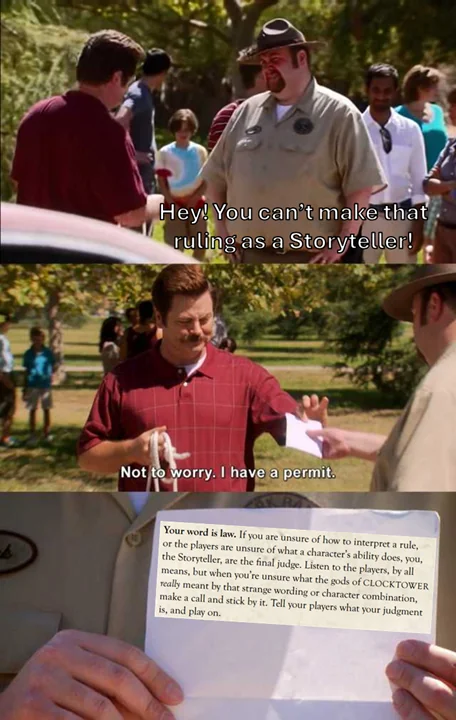
Your Word is Law
You have a Permit.